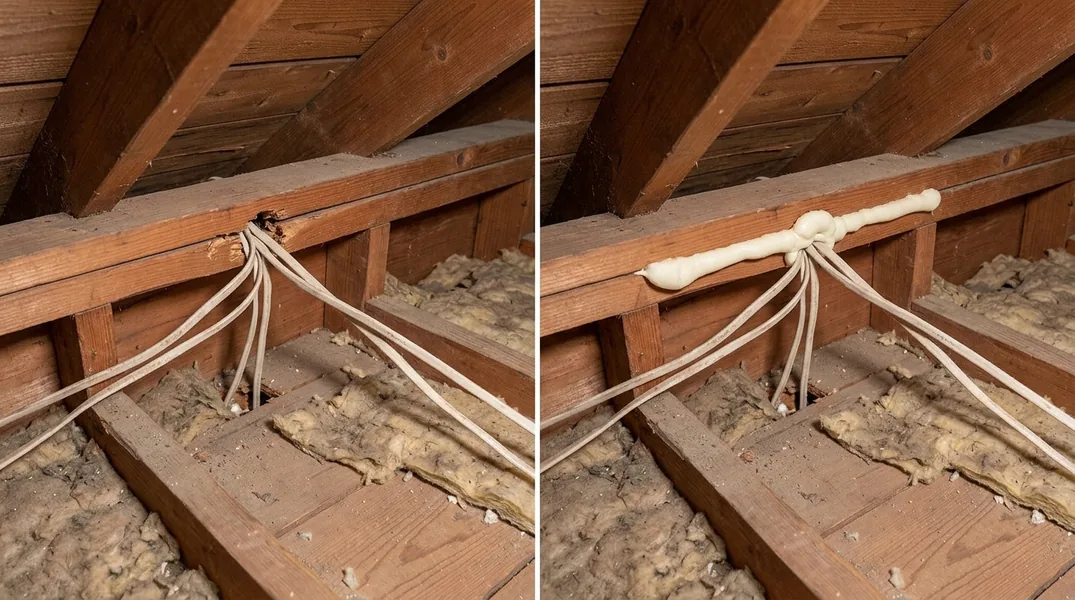
Understanding the Difference: Air Sealing vs. Spray Foam
When homeowners in Wichita start thinking about improving their home's energy efficiency, they often encounter two main approaches: air sealing and spray foam insulation. While both serve the goal of reducing energy loss, they work in fundamentally different ways and serve different purposes in your home's thermal envelope.
Air sealing is the process of identifying and closing gaps, cracks, and leaks throughout your home using caulk, weatherstripping, or other sealants. These small openings might seem insignificant, but they're responsible for substantial energy waste. According to building science research, air leaks can account for 25 to 40 percent of heating and cooling loss in older homes. Air sealing targets specific problem areas like window frames, door jambs, electrical outlets, and ductwork connections.
Attic Spray Foam Insulation, by contrast, is a comprehensive insulation solution that fills cavities and creates an air-tight barrier simultaneously. Unlike traditional fiberglass batts or blown-in cellulose, spray foam expands to fill every nook and cranny, providing both insulation value and air sealing in one application. The key difference is that spray foam acts as both an insulator and an air barrier, whereas traditional air sealing is typically a preparatory or supplementary measure.
Spray Foam Insulation R-Value Per Inch: What You Need to Know
One of the most important factors in choosing an insulation solution is understanding R-value, which measures thermal resistance. The higher the R-value, the better the insulation performs. However, different insulation types achieve R-value in different ways, and this is where spray foam has a significant advantage for many Wichita homeowners.
Closed Cell Spray Foam Insulation delivers approximately 6.0 to 7.0 R-value per inch, making it one of the most efficient insulation materials available. This means that a 4-inch application provides an R-value of roughly 24 to 28, comparable to 8 to 10 inches of traditional fiberglass batts. Open Cell Spray Foam Insulation, while less dense, still provides 3.5 to 3.7 R-value per inch, which is significantly better than standard blown-in insulation at 2.5 to 3.5 R-value per inch.
The practical benefit is clear: spray foam requires less thickness to meet building code requirements, which means it takes up less valuable attic space and delivers superior performance in a smaller footprint. For homeowners concerned about how thick spray foam should be in their attic, the answer depends on your local climate zone and specific energy goals, but the efficiency of spray foam means you'll need less material than traditional options.
R-Value Requirements by State: Kansas Standards Explained
Kansas, where Wichita is located, falls into climate zone 5A, which has specific insulation requirements for residential buildings. The International Energy Conservation Code (IECC) and Kansas building codes recommend minimum attic insulation R-values of R-38 to R-49 for this climate zone, depending on whether you're building new or renovating existing structures.
For new construction in Kansas, the 2021 IECC standard typically calls for R-49 in attics. For existing homes undergoing renovation, R-38 is often the minimum target, though many energy-conscious homeowners opt for R-49 to maximize long-term savings. To achieve R-49 with spray foam, you would need approximately 7 to 8 inches of closed cell foam or 13 to 14 inches of open cell foam. Compare this to traditional fiberglass, which would require 15 to 16 inches of batts, and the space-saving advantage becomes obvious.
Understanding these state-specific requirements is crucial because they directly impact your energy costs and comfort. A properly insulated attic maintains more consistent indoor temperatures, reduces the workload on your HVAC system, and extends the lifespan of your roofing materials by preventing ice dams in winter. When you're evaluating whether to invest in spray foam, knowing that you're meeting or exceeding Kansas standards provides peace of mind and ensures your investment protects your home's value.
Attic Spray Foam Insulation Cost in Wichita: What to Budget
Cost is often the first concern for homeowners considering any home improvement project. Spray foam insulation typically costs more upfront than traditional insulation methods, ranging from $1.50 to $3.50 per board foot for closed cell foam and $0.60 to $1.50 per board foot for open cell foam. For a typical 1,500 square foot attic, homeowners might expect to invest between $3,000 and $8,000 depending on the foam type and thickness required.
However, this higher initial investment often pays dividends through energy savings. Homeowners who install spray foam typically see 15 to 30 percent reductions in heating and cooling costs, with payback periods of 5 to 10 years in many cases. Beyond the direct energy savings, spray foam adds value to your home, improves comfort year-round, and can extend the life of your HVAC system by reducing its workload.
Incentives change often, so check what applies to your home before you budget: some utilities offer insulation rebates, and a tax professional can tell you whether any current tax credit applies to your project. To understand your specific costs and available incentives, contact Wichita Spray Foam Insulation at (316) 618-7858 for a free estimate.
How Thick Should Spray Foam Be: Finding the Right Balance
Determining the appropriate thickness for spray foam insulation depends on several factors, including your climate zone, your home's current insulation level, your energy goals, and your budget. For homeowners in Kansas, the minimum recommendation to meet state codes is typically 7 to 8 inches of closed cell spray foam for attics, which achieves the R-49 standard.
However, more thickness isn't always better if your goal is simply energy efficiency. Once you've met or exceeded your state's R-value requirements, additional thickness provides diminishing returns on investment. Many homeowners find that R-38 to R-49 represents the sweet spot between performance and cost. That said, if you plan to stay in your home for 20+ years or want to maximize comfort and minimize future energy costs, investing in the higher R-49 standard makes sense.
The beauty of spray foam is its flexibility. Whether you choose Closed Cell Spray Foam Insulation for maximum R-value per inch or open cell for a more budget-friendly option, your insulation contractor can customize the application to your specific needs. During your consultation, they'll assess your attic's current condition, identify air leaks, and recommend the thickness that balances your comfort goals with your budget.
When to Choose Air Sealing, When to Choose Spray Foam
So which solution is right for your home? The answer often depends on your current situation and long-term goals. Air sealing alone is most appropriate if your home already has adequate insulation but you've noticed drafts, uneven temperatures, or higher-than-expected utility bills. If you can identify specific problem areas like leaky windows, gaps around electrical outlets, or unsealed ductwork, air sealing can deliver impressive results at a lower cost.
Spray foam becomes the better choice if your attic insulation is below current code standards, if you want a comprehensive solution that addresses both insulation and air sealing simultaneously, or if you're planning to stay in your home long-term. Wall & Injection Foam Insulation is particularly valuable for older homes where adding traditional insulation to existing walls is difficult or impossible.
Many homeowners benefit from a combination approach. A professional energy audit can identify where your home is losing the most energy, allowing you to prioritize investments strategically. For homes in Wichita with older attics, spray foam combined with targeted air sealing often delivers the best results. The team at Wichita Spray Foam Insulation can assess your specific situation and recommend the most cost-effective solution. Call (316) 618-7858 today to schedule your free estimate and learn which approach is right for your home.
Looking for a professional spray foam insulation contractor in Wichita? Wichita Spray Foam Insulation responds fast for all your spray foam insulation needs.
Get a Free Quote