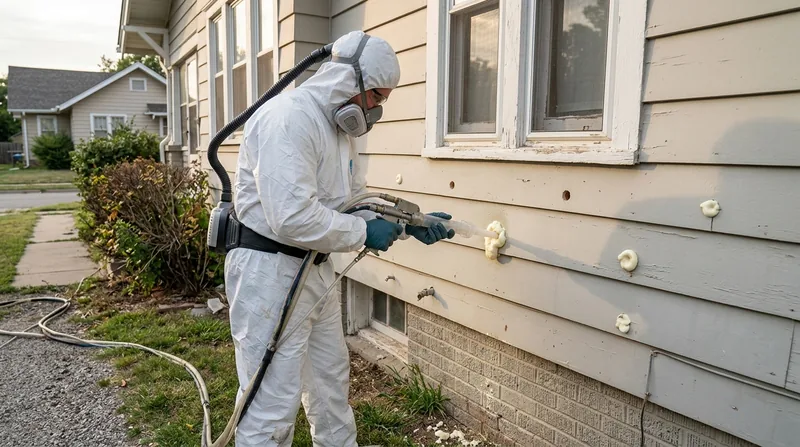




Wall & Injection Foam Insulation in Wichita fills hollow wall cavities in older homes without tearing open exterior siding. The 1920s and 1940s bungalows in College Hill, Riverside and Delano, along with countless 1950s and 1960s ranches across the metro, were built with thin wall cavities and minimal air sealing. Wichita's cold, windy winters and humid summers drive air through every gap in those walls, and energy bills climb fast. Injection foam reaches into cavities from outside through small drilled holes, then the holes are patched to match. It is one of the few ways to insulate an old wall without demolition, and it works. We have been doing this work since 2014, and we know Wichita's housing stock inside out. Learn more about our full range of spray foam and air sealing services.
Why Wall Injection Foam Matters in Wichita's Older Neighborhoods
The 1920s through 1960s homes that dominate Wichita, Derby, Andover and Haysville were framed with 2x4 studs and minimal cavity insulation. Many have no insulation at all in the walls. Fiberglass batts, when present, often settled or were installed with gaps. The result is a thin thermal barrier and a direct air path from outside to inside. Wichita sits in IECC climate zone 4A, where winter wind cuts across the open plains and finds every gap. Summer heat pours through uninsulated walls into air-conditioned homes. Injection foam seals the entire cavity and stops that flow without opening the wall.
- Injection foam fills hollow cavities completely, leaving no air gaps or settling risk.
- The process drills small holes from outside and patches them to match your existing siding.
- No drywall removal, no interior disruption, no weeks of reconstruction.
- Works on brick, wood siding, vinyl, stucco and stone without damage to the finish.
- Improves heating and cooling efficiency, especially in homes built before 1970.
For older Wichita homes with hollow walls and rising energy bills, injection foam is often the most practical retrofit solution available.
Local example: A 1950s ranch in Riverside with original 2x4 walls and no wall insulation can be retrofitted with injection foam in one day. Holes are drilled at the top and bottom of each cavity from outside, foam is injected to fill, and holes are patched. The homeowner stays inside. Cost is typically lower than adding insulation to an attic, and the payoff in winter heating is immediate.
For more on how air sealing works hand-in-hand with injection foam, see our air sealing page.
Wichita's building code and permits vary by city. Always check with your local building department to confirm what is required at your address. Some jurisdictions require permits for wall insulation work, others do not. We help homeowners understand what applies, and we work with the local building official.
How We Install Wall & Injection Foam Insulation in Wichita
Injection foam installation is a precise, methodical process. We start with a site inspection to locate studs, utilities and any obstacles inside the wall. We drill small access holes (typically 1 to 1.5 inches) through the siding at the top and bottom of each cavity, or at intervals if the wall is very tall. We inject low-pressure foam into the cavity, which expands to fill voids and seal air leaks. Once the foam sets, we patch the holes with foam-compatible caulk or filler, and we paint or stain the patches to match your siding. The entire job is done from outside, and your home stays fully occupied and functional.
- We inspect the wall from outside and identify the stud spacing, utilities and best injection points.
- We drill small access holes through the siding at top and bottom of each cavity.
- We inject foam at a controlled rate and pressure to fill the cavity completely without overpressure.
- We allow the foam to cure fully (typically 24 to 48 hours) before we patch the holes.
- We patch all holes with caulk, sealant or filler matched to your siding color and texture.
- We paint or stain patches as needed so they blend seamlessly with the existing exterior.
The entire process is clean, quiet and non-invasive. No walls are opened, no drywall is replaced, and no interior finishes are disturbed.
Wichita example: A 1940s bungalow in Delano with brick exterior and 2x4 wood-frame walls can be injected without disturbing the interior. We drill through the mortar joints or through the wood framing from the outside, inject foam into each cavity, and patch with mortar or paintable sealant. The brick face stays intact, and the homeowner never sees the work happen inside.
For details on how injection foam compares to other retrofit options, visit our insulation replacement page.
| Approach | Description | Best for |
|---|---|---|
| Injection Foam (Closed Cell) | Low-pressure polyurethane foam injected into hollow cavities through small drilled holes, fills completely, cures hard, high R-value per inch. | Hollow walls in older homes, no interior access, exterior finish must be preserved, maximum thermal and air barrier needed. |
| Injection Foam (Open Cell) | Lower-density foam injected through same holes, expands more, cures softer, lower R-value per inch but lower cost and better sound dampening. | Budget-conscious retrofit, interior walls where sound control matters, homes where maximum thermal barrier is not the only goal. |
| Blown-In Fiberglass or Cellulose | Loose-fill insulation blown into cavities through holes, lower cost, settles over time, does not air seal, requires interior wall access or exterior siding removal. | Budget retrofit if cavities are accessible from inside, supplemental insulation in newer homes, situations where air sealing is handled separately. |
| Interior Drywall + Batt Insulation | Remove interior drywall, install batts or spray foam, replace drywall, full interior reconstruction required. | Homes where interior walls are already open, new construction, major renovations where interior finishes are being replaced anyway. |
Wall & Injection Foam Insulation Cost in Wichita: What to Expect
Wall injection foam typically starts at $2 per square foot of wall area, but the final cost depends on several factors. The size of the wall, the number of cavities, stud spacing, the type of siding (brick costs more to patch than wood or vinyl), and access difficulty all affect the price. A small project on one wall of a ranch might run $800 to $1,500. A larger retrofit on multiple walls of a 1920s bungalow could be $3,000 to $6,000 or more. The best way to know is to get a free written estimate with R-value and thickness specifications included. We respond within 24 hours and there is no obligation to book.
Injection foam is almost always cheaper than opening walls and replacing drywall, and it delivers better air sealing than blown-in fiberglass or cellulose. It is also faster, because there is no interior reconstruction. For Wichita homeowners with older homes and rising heating and cooling bills, injection foam is one of the highest-value retrofit investments available. See our full pricing overview for detailed ranges.
Factors that move the cost up include: brick or stone siding (requires mortar patching), deep cavities or tall walls (more drilling points), utilities in the wall (requires careful routing), and poor exterior access (scaffolding or lifts). Factors that keep cost down include wood or vinyl siding (easier patching), single-story walls, and open yard space for equipment. We always provide a written estimate before we start work, so you know exactly what you are paying for.
What to Look for When Hiring a Spray Foam Insulation Contractor Near Wichita
Hiring a spray foam contractor is a decision that affects your home's comfort and energy bills for decades. The market includes local independents, national franchises, and one-off crews with a trailer and no accountability. Here is how to tell the difference and make sure you are working with a contractor you can trust.
- Ask for a written estimate that includes R-value, foam thickness, and the square footage of wall area to be treated.
- Verify that the contractor is fully insured and ask to see a certificate of insurance naming your address as additional insured.
- Call at least two other customers and ask about the quality of the install, the professionalism of the crew, and whether they would hire the same contractor again.
- Confirm that the contractor understands local building code and permitting requirements for your city (Wichita, Derby, Andover, etc.) and is willing to work with the building department if a permit is required.
- Get a second and third estimate. Price alone is not a predictor of quality, but a price far below market (more than 30 percent below the average) is often a warning sign of corner-cutting or poor workmanship.
- Ask about the crew's experience with your type of wall (brick, wood, vinyl siding) and your home's age and construction (1920s bungalow, 1950s ranch, etc.).
- Confirm that the contractor uses manufacturer-approved equipment and follows the foam system's mixing ratio, drum temperature and application procedures exactly.
- Understand the warranty on workmanship (typically one to three years) and ask what it covers.
A local contractor with a local address, local phone number and local references is your best protection. Contact us for a free estimate and we will answer all your questions.
Wall & Injection Foam Insulation in Wichita: Pricing Guide
| Service | Price | Details |
|---|---|---|
| Wall Injection Foam (Closed Cell) | Starting at $2/sq ft | Complete cavity fill with high R-value foam, includes drilling, injection, patching and painting matched to siding color |
| Wall Injection Foam (Open Cell) | Starting at $1.25/sq ft | Lower-cost option for budget-conscious retrofit, good for sound control, less thermal resistance per inch than closed cell |
| Multi-Wall or Large Project | On estimate | Complex siding (brick, stone), tall walls, multiple cavities or difficult access require on-site inspection for accurate pricing |
| Travel and Mobilization | Included | No separate travel fee for Wichita and surrounding service areas, equipment and crew mobilization included in project estimate |
| Free Written Estimate | Free | Detailed estimate with R-value, thickness and square footage, response within 24 hours, no obligation to book, call (316) 618-7858 |
Indicative pricing, the exact cost depends on square footage, finish, and site access. Free personalized estimate within 24h at (316) 618-7858.


