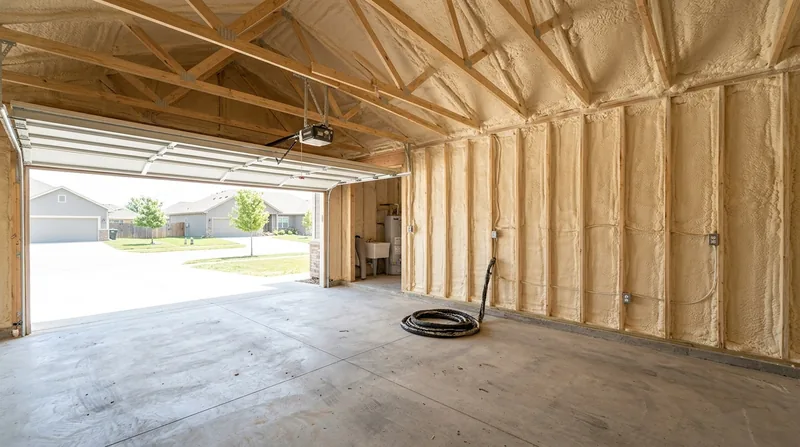




Wichita garages swing from brutal summer heat to freezing winter wind across Sedgwick County, and an uninsulated or poorly sealed garage ceiling bleeds conditioned air into your attached house and wastes energy on both sides of the wall. Garage spray foam insulation in Wichita stops that transfer by sealing the ceiling and walls with a continuous thermal and air barrier that holds steady temperatures year-round. The region's 1950s-70s ranches and newer subdivisions in Derby, Andover, and Maize all share the same problem: open-plains wind drives air through every gap in a garage structure, and the attached house loses heat in winter and cool air in summer because the garage becomes a thermal sieve. We foam the garage ceiling and walls to cut drafts, stabilize temperatures, and reduce the load on your home's heating and cooling system. Spray foam is measured on site by the board foot, so your cost depends on ceiling area, wall coverage, and the R-value you choose. Call us at (316) 618-7858 for a free written estimate with R-value and thickness specs, or visit our pricing page to understand what moves the needle on cost.
Why Garage Spray Foam Insulation Matters in Wichita's Climate
A typical Wichita garage is vented or partially sealed, which means summer heat radiates through the ceiling into the attic space above, and winter wind finds every crack in the door frame, wall seams, and rim joist where the garage meets the foundation. If your garage is attached to your house, that temperature swing drives air leaks into your living space and forces your furnace and air conditioner to work harder. The open-plains wind that defines Sedgwick County doesn't just cool the exterior; it pressurizes the garage and pushes cold or hot air through wall cavities and into the conditioned house. Spray foam stops that flow.
- We seal the garage ceiling with closed or open cell foam to block radiant heat transfer and air movement into the attic above.
- We foam the top of exterior walls and any rim joist to stop wind-driven air leakage at the foundation line.
- We seal penetrations around electrical outlets, door frames, and any mechanical chases that connect the garage to the house.
- The result is a stable garage temperature that protects your attached home and cuts the cycling load on your heating and cooling system.
A sealed garage also protects vehicles and stored items from temperature extremes, reduces condensation on metal doors and frames, and eliminates the drafts that make garages uncomfortable to work in during winter.
Key info: In Wichita and nearby areas like Bel Aire and Maize, attached garages are the norm, and the garage-to-house thermal bridge is one of the biggest energy leaks in mid-century ranches and newer subdivisions. Spray foam breaks that bridge and pays for itself through lower utility bills and better comfort year-round. For more on air sealing and thermal barriers, see our air sealing page.
How We Insulate Garages in Wichita: Our Process
We start with a site visit to measure the ceiling area, identify wall cavities and rim joists that need sealing, and assess access and any existing insulation or debris that must be removed first. We discuss your R-value target, explain the difference between closed cell (higher R-value, better moisture control, more expensive) and open cell (lower cost, good air sealing, lighter density), and give you a written estimate with thickness and performance specs. Once you approve, we schedule the work, set up containment and ventilation, and spray the foam in passes that allow each layer to cure before the next application.
- We inspect the garage ceiling, walls, and rim joist to identify all air leaks and thermal bridges that need sealing.
- We remove any existing insulation or debris that would interfere with foam adhesion and cure.
- We mask and protect areas outside the spray zone, set up mechanical ventilation during application and cure, and establish a re-entry window of 24 to 48 hours.
- We spray the foam in controlled passes, building thickness layer by layer to the R-value and dimensions specified in your estimate.
- We apply a thermal barrier if code requires it, and we leave the space clean and ready for your use within the stated timeframe.
The entire process from estimate to completion typically takes one to two weeks, depending on schedule and cure time.
Example: A 400-square-foot garage ceiling in Wichita with R-30 open cell foam takes one day to spray and 24 to 48 hours to cure. A 500-square-foot garage with wall insulation and rim joist sealing in Andover or Park City may take two days of work and five to seven days of elapsed time. We give you a schedule upfront so you can plan around it.
Garage Spray Foam Insulation Methods and Foam Types
| Approach | Description | Best for |
|---|---|---|
| Open Cell Spray Foam | Low-density foam with an open cellular structure, R-value approximately 3.6 per inch, air sealing and sound dampening, cost-effective. | Garage ceilings where R-20 to R-30 is sufficient, budget-conscious homeowners, and projects where sound control matters. |
| Closed Cell Spray Foam | High-density foam with a closed cellular structure, R-value approximately 6 to 7 per inch, superior moisture control, higher cost. | Garage walls exposed to weather, rim joists, and any area where vapor control or structural support is critical. |
| Ceiling-Only Foam | Spray foam applied to the underside of the garage roof deck or ceiling joists, leaving walls unfoamed. | Garages where the primary heat loss is through the ceiling and wall air leakage is minimal or already sealed. |
| Ceiling Plus Wall and Rim Joist | Comprehensive foam package covering the ceiling, exterior walls, and the rim joist where the garage meets the foundation. | Attached garages in Wichita and Derby where the garage-to-house thermal bridge is a major source of drafts and energy loss. |
For closed cell spray foam details and R-value specifications, see our dedicated closed cell page. For budget-conscious ceiling-only work, open cell spray foam delivers excellent air sealing at a lower cost per board foot.
Garage Spray Foam Insulation Cost in Wichita: What to Expect
Garage spray foam insulation in Wichita typically starts at $1,200 for a small ceiling-only project and ranges upward based on ceiling area, wall coverage, foam type, and R-value. A typical 400 to 500 square foot garage ceiling with R-30 open cell foam runs $1,500 to $2,500. If you add wall insulation or rim joist sealing, or if you choose closed cell foam for moisture control, the cost rises. Access, existing insulation that must be removed, and the complexity of penetrations and mechanical chases also move the price. The best approach is to get a free written estimate from us that spells out the square footage, R-value, foam type, and total board feet so you understand exactly what you are paying for and why. Visit our pricing page for a detailed breakdown, or call (316) 618-7858 for a no-obligation estimate within 24 hours.
Garage Spray Foam Insulation Near Me: What Wichita Homeowners Should Know When Hiring
When you are ready to hire a spray foam contractor for your garage in Wichita, Maize, Derby, or any of the surrounding towns, verify that the contractor is fully insured and can provide proof of current coverage. Ask for a detailed written estimate that includes the R-value, thickness in inches, total board feet, and the foam type (open cell or closed cell). Check references from recent garage or attic projects in your area, and confirm that the contractor will provide mechanical ventilation during application and cure, with a clear re-entry window stated upfront. Understand your city's permitting rules by contacting your local building department; most garage insulation does not require a permit, but some cities flag sealed attics or specific foam applications. If your garage is in a master-planned community or HOA, check whether any exterior work on the garage requires architectural approval.
- Verify that any contractor you hire is fully insured and can provide a certificate of insurance on request.
- Get a written estimate with R-value, thickness, board feet, and foam type clearly stated so you can compare apples to apples.
- Ask how the contractor handles mechanical ventilation during cure and what re-entry window they guarantee.
- Check references from at least two recent projects in Wichita, Andover, or nearby towns to confirm quality and reliability.
- Confirm whether your city or county requires a permit for garage insulation by contacting your local building department.
- Contact us for a free estimate and compare our approach, pricing, and references against other local contractors.
Red flags include a contractor who quotes a price per board foot without seeing the space, promises immediate re-entry without stating a cure window, or cannot provide proof of insurance. The cheapest estimate is rarely the best value; a mid-market bid from a contractor with local references and clear workmanship terms is the safer choice.
Garage Spray Foam Insulation in Wichita: Pricing Guide
| Service | Price | Details |
|---|---|---|
| Garage ceiling only (R-20 to R-30) | Starting at $1,200 | Open cell foam on a 350 to 400 square foot ceiling, includes removal of debris and basic air sealing of penetrations |
| Garage ceiling plus walls and rim joist | Starting at $2,000 | Comprehensive insulation and air sealing of ceiling, exterior walls, and rim joist line where garage meets foundation |
| Closed cell foam upgrade | Starting at $1,800 | Higher R-value per inch and superior moisture control compared to open cell, cost moves up with board feet and coverage area |
| Existing insulation removal and re-insulation | On estimate | Removal of old fiberglass or cellulose, disposal, and spray foam installation requires site assessment for scope and debris volume |
| Travel and estimate | Included in Wichita area | No mileage fee or travel charge for service areas in Sedgwick County and surrounding towns; free written estimate within 24 hours |
Indicative pricing, the exact cost depends on square footage, finish, and site access. Free personalized estimate within 24h at (316) 618-7858.


