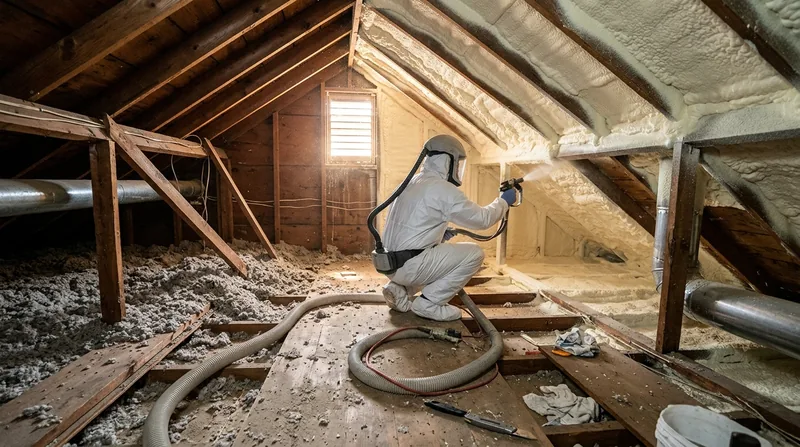




Insulation Replacement & Re-Insulation in Wichita means tearing out failed or inadequate insulation and installing new spray foam sized for your home's age, location, and the energy code that applies at your address. Wichita's housing stock spans 1920s bungalows in College Hill and Riverside, 1950s-70s ranches built during the aircraft boom, and newer subdivisions stretching across Sedgwick, Butler, and Harvey counties. Many of these homes still carry fiberglass batts, blown cellulose, or even older mineral wool that has settled, compacted, or absorbed moisture over decades. The region sits in IECC climate zone 4A with humid summers and cold, windy winters, and the open plains drive air through every gap in a wall or attic. When insulation fails, heating and cooling bills climb fast. We swap worn material for new spray foam that seals air leaks and holds its R-value, keeping your home comfortable and your energy costs down. Start with a free estimate to see what your home needs.
Why Insulation Replacement Matters in Wichita's Older and Mid-Century Homes
Wichita's 1920s bungalows and 1950s ranches were built with materials and standards that no longer meet today's energy code or performance expectations. Fiberglass batts settle and separate from framing, creating voids that leak air. Blown-in cellulose absorbs moisture from Wichita's humid summers and loses R-value. Older homes often have thin wall cavities, poorly sealed top plates, and attics with no thermal or air barriers at all. The wind-driven heating and cooling loads on these homes are severe, and failed insulation compounds the problem. When you replace old insulation with new spray foam, you restore the thermal envelope, eliminate air leaks at the same time, and reduce the work your HVAC system has to do. That translates to lower bills, better comfort, and a home that stays warm in winter and cool in summer.
- Fiberglass batts compress and separate from framing over 20 to 30 years, creating thermal bridging and air pathways.
- Blown-in cellulose and mineral wool absorb moisture in humid climates and lose R-value as they pack down.
- Older attics have no air barrier between conditioned space and vented attic, letting winter wind strip heat and summer heat pour in.
- Wall cavities in pre-1950 homes are often 3.5 inches deep with no insulation at all, making retrofit foam the only non-invasive option.
- Top plates, band joists, and rim joists in basements are classic thermal and air-leak zones that new foam seals in one pass.
Replacing insulation is not a cosmetic upgrade. It is the foundation of energy efficiency and the precondition of comfort in Wichita's climate.
Key info: In Wichita, Derby, Andover, and Maize, attic insulation is typically vented (open to outside air) in older homes, which means summer heat gets trapped and winter wind blows through. Replacing vented attic insulation with a sealed, unvented attic using spray foam stops that cycle and cuts energy bills significantly. Check your local building department to confirm whether a sealed attic requires mechanical ventilation at your address.
How Insulation Replacement Works: Our Process in Wichita
We start with a site visit to assess what is in place, measure thickness and coverage, and identify air leaks. We confirm what the energy code requires at your address and what spray foam system (closed cell or open cell) makes sense for your space. We then schedule removal of old insulation, clean and prep the cavity, and spray new foam to the thickness and R-value specified in our written estimate. The foam cures over 24 to 48 hours, during which we ask you to stay out of the space and provide mechanical ventilation if the area is occupied. Once cured, the foam is permanent, will not settle, and seals air leaks as it expands and fills voids.
- We inspect the existing insulation, measure thickness, and note any moisture, settling, or damage.
- We verify the energy code requirement for your address and recommend closed cell or open cell foam based on your climate zone and end use.
- We schedule removal of old material and properly dispose of it in compliance with local waste rules.
- We prep the cavity, seal large gaps and penetrations with foam or caulk, and confirm drum temperature and equipment calibration.
- We spray foam in controlled passes, measuring thickness on site and documenting R-value and board footage in our final report.
- We provide a re-entry window of 24 to 48 hours and confirm mechanical ventilation is running during cure if the space is occupied.
The result is a permanent, settled insulation that seals air leaks and holds its R-value for the life of the building.
Example: A 1960s ranch in Wichita with a vented attic over the main floor had 4 inches of settled fiberglass and an R-value of about 11. We removed it, sealed air leaks at the top plates and around the attic hatch, and sprayed 5.5 inches of open cell foam for an R-value of 21. The homeowner saw a 20 percent drop in cooling bills the first summer and a 15 percent drop in heating bills the following winter.
Learn more about attic spray foam insulation and insulation removal to understand the full scope of what is involved.
Insulation Replacement Methods: Closed Cell vs. Open Cell Foam
| Approach | Description | Best for |
|---|---|---|
| Closed Cell Spray Foam | High-density foam (1.5 to 2.0 pcf) with an R-value of 6.0 to 6.5 per inch. Vapor barrier. Resists moisture and air infiltration. | Rim joists, basement walls, sealed attics, crawl spaces with moisture risk, metal buildings, and any space where condensation control is critical. |
| Open Cell Spray Foam | Low-density foam (0.5 pcf) with an R-value of 3.6 per inch. Vapor-permeable. Lighter and less expensive than closed cell. | Attics in dry climates, interior walls where air sealing is the primary goal, and sound dampening in garages and workshops. |
| Blown-In Fiberglass or Cellulose Top-Up | Adding loose-fill material over existing settled insulation without removal. Fast and low-cost but does not seal air leaks. | Attics with sound, evenly distributed insulation that is simply too thin. Not recommended in Wichita's humid climate or where air sealing is needed. |
| Full Removal and Spray Foam Replacement | Remove all old material, prep the cavity, and spray foam to the required thickness. Addresses settling, moisture, and air leaks in one project. | Any home where old insulation has failed, settled, or absorbed moisture. The standard approach for 1920s-70s homes in Wichita. |
Wichita's climate and older housing stock favor closed cell spray foam in basements, rim joists, and sealed attics, where moisture risk is real. Open cell foam works well for attic-only jobs where the space is dry and air sealing is the goal. The right choice depends on your specific space, climate zone, and end use.
Insulation Replacement & Re-Insulation Cost in Wichita: What to Expect
Insulation replacement cost depends on the square footage of the space, the thickness and R-value required, whether old material must be removed, and access to the cavity. A typical attic replacement in a Wichita 1950s ranch runs from $2,800 to $5,500, depending on attic size and whether the job includes air sealing at top plates, penetrations, and the attic hatch. Basement rim joists or a crawl space may run $1,500 to $3,500 for closed cell foam. A full-home wall retrofit using injection foam is higher-ticket, often $4,000 to $8,000 or more, because it involves multiple wall cavities and careful drilling. Get 2 to 3 written estimates that include R-value, thickness, board footage, and labor. Avoid any quote that does not specify these details or that promises a price far below market. See our full pricing guide for ranges by service type and what moves the number up or down.
Insulation Replacement & Re-Insulation Near Me: What to Look for When Hiring a Spray Foam Contractor
Hiring the right spray foam contractor is the difference between a job that saves money for 30 years and one that creates headaches. Look for a contractor who provides a written estimate with R-value, thickness, and board footage. Ask to see proof of insurance and check references from recent jobs in Wichita or nearby suburbs like Derby, Andover, or Maize. Verify that the contractor understands your local building code, including attic ventilation rules and thermal barrier requirements, which vary by city and address. Ask whether permits are required for your specific project and which party is responsible for pulling them. If you are in a master-planned community, check HOA architectural rules for any restrictions on exterior work or material color. Never hire a contractor who promises immediate re-entry or who does not mention mechanical ventilation during cure. A reputable contractor will explain the curing timeline (24 to 48 hours) and will not promise results that violate code or best practice.
- Verify that the contractor is fully insured and can provide a certificate of insurance on request.
- Request a written estimate that specifies R-value per inch, total thickness, board footage, and labor cost separately.
- Ask for references from jobs completed in Wichita, Derby, Andover, or other nearby areas within the past 12 months.
- Confirm that the contractor understands your local building code, including whether your attic is vented or sealed and what thermal barrier is required.
- Ask who is responsible for pulling permits and what the timeline is for inspection and approval.
- Discuss the curing timeline and confirm that the contractor will provide mechanical ventilation during cure if your space is occupied.
A local contractor with a local address, local plates, and a track record in your neighborhood is your best bet. Contact us today for a free, no-obligation estimate and to ask any questions about your specific project.
Insulation Replacement & Re-Insulation in Wichita: Pricing Guide
| Service | Price | Details |
|---|---|---|
| Attic Insulation Replacement (typical 1,200 to 1,500 sq ft) | Starting at $2,800 | Removal of old material, prep, spray foam to code-required R-value, and air sealing at top plates and penetrations included |
| Basement Rim Joist or Crawl Space Replacement (per linear foot or per zone) | Starting at $1,500 | Closed cell foam sprayed to 2 to 3 inches, moisture barrier included, typical basement perimeter or crawl space enclosure |
| Wall Cavity Injection Foam Retrofit (pre-1980 homes, multiple cavities) | Starting at $4,000 | Drilling, injection, and sealing of wall cavities across one or more floors, labor-intensive and priced per board foot on site |
| Metal Building or Garage Interior Replacement | Starting at $3,200 | Closed cell spray foam on metal substrate for condensation control, typical single-bay garage or small shop |
| Complex or Multi-Zone Project | On estimate | Combination of attic, walls, and rim joist work, or homes with unusual geometry, moisture issues, or access challenges |
| Free Estimate | No charge | Written proposal with R-value and thickness specs, response within 24 hours, call (316) 618-7858 to schedule |
Indicative pricing, the exact cost depends on square footage, finish, and site access. Free personalized estimate within 24h at (316) 618-7858.


