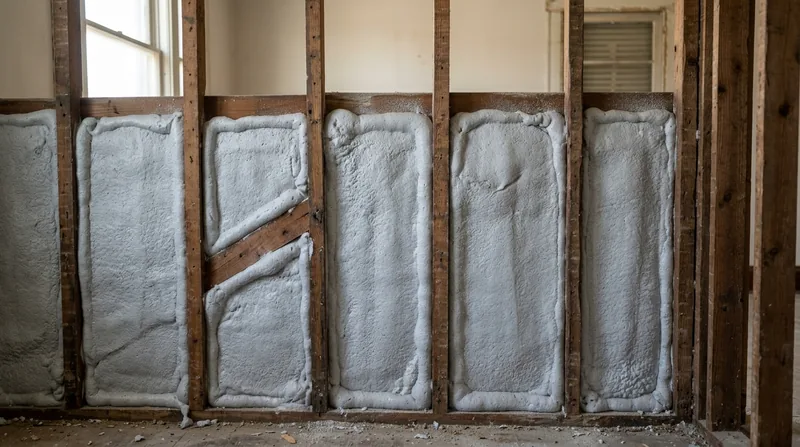




Open cell spray foam insulation in Wichita fills the wall cavities of the College Hill bungalows built in the 1920s and 1930s, the mid-century ranches that rose during the aircraft boom, and the newer subdivisions stretching into Derby, Andover, and Maize. Wichita sits in IECC climate zone 4A, where humid summers and cold, windy winters drive air through every gap in a wall. The plains wind is relentless, and the thin wall cavities of older homes leak heat and cool air at a steady cost. Open cell foam expands to fill those gaps, seals the top plates and rim joists where air sneaks in, and stops the draft that no amount of weatherstripping can fix. It costs less than closed cell foam and works well in interior walls where moisture control is not the primary concern. We help homeowners across greater Wichita understand when open cell is the right choice and when another method makes more sense.
Why Open Cell Spray Foam Matters in Wichita's Mixed Housing Stock
Wichita's housing spans nearly a century of construction, and the failure modes are different in each era. The 1920s and 1930s bungalows in College Hill, Riverside, and Delano have thin balloon-framed walls with no continuous insulation and no air barrier. The 1950s through 1970s ranches that dominate the city were built with fiberglass batts or blown-in cellulose, both of which settle, compress, and lose contact with the studs over decades. Newer subdivisions in Derby, Andover, Bel Aire, and Maize often have better insulation, but the top plates, band joists, and penetrations still leak air. Open cell foam seals all of these gaps in one pass, fills the full cavity depth, and adheres to the studs so it stays in contact with the thermal boundary.
- Open cell foam expands to fill irregular cavities and seal gaps that fiberglass and blown-in insulation cannot reach.
- It reduces air infiltration through the walls, which is the dominant heat loss mode in Wichita's windy plains climate.
- It is less expensive than closed cell foam and works well for interior walls where vapor control is not critical.
- It provides sound dampening, which helps in older homes with thin walls and in newer construction near busy streets.
- It can be installed in existing walls without demolition, making it the retrofit choice for pre-1980 homes across the metro.
The open plains wind that defines Wichita's weather is also the reason air sealing matters as much as insulation thickness. A wall with R-19 open cell foam and all gaps sealed performs better than a wall with R-21 fiberglass and air leaks.
Key info: Wichita's 1950s ranch homes often have fiberglass batts that have settled 2 to 4 inches below the top plate, leaving a 6-inch air gap that bleeds conditioned air into the attic. Open cell foam applied to the interior of the top plate stops that leak permanently.
For more detail on how air sealing and insulation work together, see our air sealing service page.
How We Install Open Cell Spray Foam in Wichita Homes
Open cell spray foam installation is a controlled process that begins with site assessment and preparation. We inspect the wall cavities, identify air leaks and thermal bridges, confirm that the substrate is dry and clean, and explain what the homeowner will experience during and after the spray. The foam is applied in thin, overlapping passes to build the specified thickness without trapping moisture or creating voids. Mechanical ventilation runs during cure, and we establish a clear re-entry window of 24 to 48 hours before the home is fully occupied. The result is a wall cavity that is fully insulated, air-sealed, and ready to perform.
- We assess the wall cavity, check for moisture or contamination, and confirm the substrate is sound before any foam is sprayed.
- We apply open cell foam in thin, controlled passes to build to the specified R-value and thickness without voids or compression.
- We run mechanical ventilation during cure to manage off-gassing and ensure proper chemical reaction in the foam.
- We provide a written estimate with R-value and thickness specifications so you know exactly what you are paying for.
- We establish a clear re-entry window and explain what to expect as the foam cures over the first 24 to 48 hours.
Every job in Wichita, Derby, Andover, Haysville, and the surrounding areas follows the same process: preparation, controlled application, ventilation, and a documented hand-off to the homeowner.
Example: A 1960s ranch in Park City with original fiberglass batts and a drafty top plate receives open cell foam applied to the interior of the top plate and the full depth of the wall cavities. The job takes one day, mechanical ventilation runs for 24 hours, and the homeowner re-enters the next morning. Bills for heating and cooling drop noticeably in the first season.
See our attic spray foam service page for details on how we handle attic and sealed roof deck applications, which often pair with wall insulation work.
Methods and Applications for Open Cell Spray Foam in Wichita
| Application | Description | Best for |
|---|---|---|
| Interior wall cavities (retrofit) | Open cell foam applied to the inside of exterior walls in homes built before 1980, filling the full cavity depth and sealing the top plate. | College Hill bungalows, mid-century ranches, and older neighborhoods where demolition is not an option. |
| New construction framing | Open cell foam applied to the cavities of new homes before drywall is hung, providing full thermal and air barrier coverage. | New subdivisions in Derby, Andover, Maize, and Bel Aire where the builder specifies spray foam for energy code compliance. |
| Top plate and rim joist sealing | Open cell foam applied to the junction where the top plate meets the attic, and to the rim joist band above the basement or crawl space. | All Wichita homes, especially ranches and bungalows where this joint is the single largest air leak. |
| Sound dampening in interior walls | Open cell foam applied to interior partition walls to reduce sound transmission between rooms and from outside. | Homes near busy streets, commercial buildings, and multi-unit properties where noise control is a priority. |
Open cell foam is a versatile product, but it is not the right choice for every situation. Crawl spaces with standing water, metal buildings where condensation control is critical, and sealed attics in high-humidity climates often call for closed cell foam instead. We evaluate your specific situation and recommend the method that delivers the best performance and value.
Open Cell Spray Foam Insulation Cost in Wichita: What to Expect
Open cell spray foam insulation in Wichita starts at approximately $0.55 per board foot, with most wall cavity jobs falling between $0.50 and $0.65 per board foot depending on access, cavity configuration, and the amount of prep work required. A typical 1,200-square-foot ranch with wall cavities averaging 3.5 inches deep might use 1,400 to 1,800 board feet of foam, putting the material and labor cost in the range of $770 to $1,170 before permits or site-specific contingencies. Smaller jobs, such as top plate sealing on a single story or a rim joist retrofit, run $300 to $600. Larger projects involving multiple walls, new construction framing, or difficult access may cost more.
Several factors move the price up or down. Access to the wall cavities is the biggest variable: a wall that is easy to reach from inside costs less than a wall that requires scaffolding or exterior work. Cavity depth and width affect the board footage: a 2x6 cavity holds more foam than a 2x4. Substrate condition matters: if we find wet insulation or contamination, we remove it first, which adds labor and disposal cost. Permit requirements vary by city across greater Wichita, and some jurisdictions require inspection or certification that adds a small fee.
The best way to know your actual cost is to request a free written estimate. We measure the area, calculate the board footage, and quote a firm price with R-value and thickness specifications so there are no surprises.
For a full pricing overview covering all our services and job types, see our pricing page.
What to Look for When Hiring a Spray Foam Insulation Contractor Near Wichita
Hiring the right spray foam contractor is the difference between a job that performs for decades and one that fails in a few years. The spray foam trade has two types of bad actors: out-of-state rig-and-run crews that spray a job in an afternoon, collect payment, and disappear when the smell will not go away or when the foam does not cure properly, and national franchises that charge premium prices and deliver generic work. A local contractor with a local address, local plates, and local references is your best protection.
When you are evaluating spray foam insulation contractors near you, ask these questions:
- Request a written estimate that specifies the R-value, thickness in inches, and board footage so you know exactly what you are paying for.
- Confirm that the contractor is fully insured and ask to see a certificate of insurance that names your address as an additional insured.
- Ask whether the contractor will provide mechanical ventilation during cure and establish a clear re-entry window of 24 to 48 hours.
- Check references from recent jobs in Wichita, Derby, Andover, or Maize, and ask those homeowners whether the work was done on time and whether the contractor was reachable after the job.
- Verify that the contractor understands local permitting for your city or neighborhood, and confirm whether any permits are required at your address.
- Ask about the contractor's warranty on workmanship and get it in writing; honest warranties run one to three years and cover defects in application, not performance or energy savings.
A contractor who rushes the estimate, quotes a price without specifying thickness and R-value, or says you can move back in right away is signaling that corners will be cut. The strongest indicator of quality is a contractor who spends time on site, asks detailed questions about your home and your goals, and explains the tradeoffs between open cell and closed cell foam instead of just pushing one product.
Contact us today for a free estimate and a conversation with someone who knows Wichita's housing stock and climate.
Open Cell Spray Foam Insulation in Wichita: Pricing Guide
| Service | Price | Details |
|---|---|---|
| Interior wall cavity retrofit (open cell) | Starting at $0.55/board ft | Includes assessment, foam application in controlled passes, mechanical ventilation, and R-value documentation. Access and cavity depth drive the final per-foot cost. |
| Top plate and rim joist sealing | Starting at $300 | Seals the junction where the top plate meets the attic and the rim joist above basements or crawl spaces. Price depends on linear footage and accessibility. |
| New construction framing (open cell) | Starting at $0.50/board ft | Applied before drywall hang on new homes and additions. Volume discounts apply for larger projects. Includes coordination with builder schedule and inspections. |
| Sound dampening in interior walls | Starting at $0.55/board ft | Open cell foam applied to partition walls for noise reduction. Cost depends on wall length, height, and cavity configuration in the structure. |
| Travel and site visit | Included | No separate charge for travel within Wichita and surrounding service areas. Free estimate with response within 24 hours at (316) 618-7858. |
Indicative pricing, the exact cost depends on square footage, finish, and site access. Free personalized estimate within 24h at (316) 618-7858.


