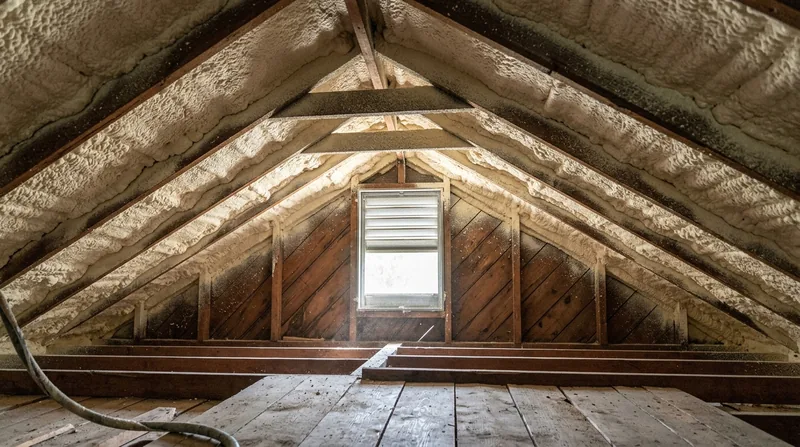




Attic spray foam insulation in Wichita stops the heat loss that drives summer cooling bills and winter heating costs across College Hill, Riverside, and the 1950s-70s ranches that define the Air Capital's residential core. Wichita sits in IECC climate zone 4A, where humid summer heat and cold, windy winters meet open plains that push air through every gap in a wall or attic floor. Most homes built before 1980 in the region have vented attics that trap summer heat and let winter wind strip warmth, while newer subdivisions in Derby, Andover, Maize, and Bel Aire still see air leaks at top plates and penetrations. We air seal the attic floor and add spray foam sized for zone 4A before seasonal demand peaks, controlling thickness per pass and mechanical ventilation during cure to deliver a finished, conditioned attic that holds temperature.
Why Attic Air Sealing and Spray Foam Matter in Wichita's Climate
Vented attics over older bungalows and mid-century ranches are the single largest source of seasonal heating and cooling loss in Wichita. The wind that sweeps across the plains finds its way through gaps at the rim joist, around ductwork, past recessed lights, and through unsealed top plates, and once winter arrives, that air leakage costs money every day. An attic with no air barrier and thin or settled insulation cannot hold temperature, and the conditioning system works continuously to replace lost air. Spray foam creates a continuous air and thermal barrier across the entire attic floor, stopping the convection that vented attics allow and lowering the load on your furnace and air conditioner.
- We identify air leaks at the rim joist, around HVAC penetrations, and at the top plates where walls meet the attic.
- We seal those gaps and apply spray foam to the attic floor at the R-value required by energy code for zone 4A.
- We control the thickness on each pass and maintain mechanical ventilation during cure to ensure the foam cures properly.
- We document the R-value and thickness in writing so you have a record for permits and future reference.
Air sealing alone on a sound attic can cut heating and cooling loss by 15 to 40 percent, depending on how many gaps were present and how large they were.
Key info: A 1950s ranch in Wichita with a vented attic and no air barrier loses conditioned air continuously through the rim joist and around ductwork. Spray foam closes those gaps and adds insulation in one step, which is why it is the standard retrofit for mid-century stock across the region.
For details on energy code requirements and attic ventilation rules that apply at your address, check with your local building department, as regulations vary by city and jurisdiction across Greater Wichita.
How We Spray Foam Your Attic: Process and Approach
We start with a walk-through to measure the attic floor, identify air leaks, and check for moisture, active leaks, or contamination that would require remediation before foam is applied. We then provide a written estimate with the R-value, foam thickness, and square footage so you know exactly what you are paying for. On the day of work, we set up mechanical ventilation, apply the foam in controlled passes, and maintain the substrate temperature and drum temperature within manufacturer specs. The foam cures over 24 to 48 hours, during which the attic is off-limits; we provide a written re-entry window so you know when it is safe to enter.
- We inspect the attic for moisture, roof leaks, or contamination and defer to you if remediation is needed first.
- We measure square footage and specify the R-value and thickness required by code for your climate zone.
- We apply foam in layers, controlling thickness per pass and maintaining mechanical ventilation during cure.
- We document the work with photos and a written record of R-value and thickness for your files.
- We provide a 24 to 48 hour re-entry window in writing so you know when the attic is safe to use again.
For homes with existing insulation, we assess whether blown-in fiberglass or removal and replacement with spray foam makes sense; on a sound attic, sometimes the simpler and cheaper option is the right one, and we tell you that straight.
Example: A 1,400 square foot attic floor in Wichita with rim joist leaks and no air barrier takes 3 to 5 hours to seal and foam to R-38. We run mechanical ventilation for the cure window, and the homeowner can re-enter after 48 hours. If the attic has settled fiberglass, we evaluate whether topping it with open cell foam or removing and replacing with closed cell makes sense for the use case and budget.
Learn more about our air sealing service and how it complements attic insulation.
Closed Cell vs. Open Cell Spray Foam for Attics in Wichita
Closed cell foam is denser, has a higher R-value per inch (around R-6 to R-6.5 per inch), and provides a vapor barrier that is useful in humid climates. Open cell foam is lighter, has a lower R-value per inch (around R-3.5 to R-3.6 per inch), and allows moisture to pass through, which works well in attics where drying to the outside is possible. In zone 4A, closed cell is the standard for sealed attics and rim joists because it stops both air and moisture, while open cell is a cost-effective choice if your attic is vented or if you are adding insulation over existing material and need fewer inches of thickness.
| Foam Type | R-Value per Inch | Best Use in Wichita Attics |
|---|---|---|
| Closed Cell | R-6 to R-6.5 | Sealed attics, rim joists, and zone 4A retrofits where vapor control is needed and space is tight. |
| Open Cell | R-3.5 to R-3.6 | Vented attics and cost-sensitive retrofits where you have room for extra thickness and moisture can dry freely. |
| Blown-In Fiberglass | R-3.2 to R-3.8 | Top-up insulation on sound attics with existing material and no air sealing needed, lowest cost per R-value added. |
| Spray Foam with Removal | R-3.5 to R-6.5 | Attics with failed or contaminated insulation, where air sealing and a fresh thermal barrier are required. |
We help you choose the right foam type and thickness based on your attic condition, your zone, and your budget. See our closed cell spray foam and open cell spray foam pages for detailed comparisons.
Attic Spray Foam Insulation Cost in Wichita: What to Expect
Attic spray foam insulation in Wichita typically starts at around $1.50 per square foot for open cell foam on a straightforward attic floor with good access. Closed cell foam, which offers higher R-value and vapor control, runs higher because of material and application complexity. The final cost depends on attic size, existing insulation (removal costs money and time), the number of air leaks to seal, roof penetrations, and how accessible the attic is. A 1,200 square foot attic with moderate air sealing needs and open cell foam to R-38 typically falls in the $1,800 to $2,400 range; a sealed attic with closed cell foam and extensive rim joist work can run $2,500 to $4,500 or more.
We provide a written estimate with the square footage, R-value, foam thickness, and total cost before any work begins. Getting 2 to 3 estimates from different contractors is smart, as pricing varies based on crew experience, equipment, and whether the estimate includes air sealing or just foam application. Visit our pricing page for detailed breakdowns and factors that move the cost up or down.
The cheapest estimate is not always the best value. An estimate with no R-value spec, no thickness listed, and a price far below market is a red flag; it often means the work will be rushed, ventilation will be skipped, and you will have no documentation of what was done. Ask any contractor for a written estimate with R-value, thickness, and square footage, and verify their insurance before booking.
Attic Spray Foam Insulation Near Me: What Wichita Homeowners Should Know When Hiring
Hiring a spray foam contractor is a big decision because the work is invisible once it is done, and a bad installation can leave you with a smell that will not go away, a warranty you cannot verify, or foam that was applied too thick or too thin. We serve Wichita, Derby, Andover, Maize, Haysville, Park City, Bel Aire, Valley Center, Goddard, Mulvane, and surrounding areas, and we are fully insured with written estimates that include R-value and thickness specs. When you are comparing contractors, ask for proof of insurance, get the estimate in writing with the R-value and thickness, and check references from recent jobs in your neighborhood.
- Verify that the contractor is fully insured and ask for a certificate of insurance that names your address as additional insured.
- Get a written estimate that specifies the R-value, foam thickness in inches, and total square footage so you can compare apples to apples.
- Ask how the contractor will ventilate during cure and what re-entry window they guarantee in writing.
- Check references from homeowners in Wichita or nearby cities who had work done in the last 12 months.
- Confirm whether the contractor pulls permits and helps you navigate what applies at your address, as rules vary by city.
- Be wary of an estimate with no written thickness or R-value, or a price far below market with no explanation.
Call us at (316) 618-7858 for a free, no-obligation estimate with R-value and thickness specs included.
Attic Spray Foam Insulation in Wichita: Pricing Guide
| Service | Price | Details |
|---|---|---|
| Open Cell Spray Foam, Attic Floor | Starting at $1.50/sq ft | Air sealing and insulation to R-38 or R-49, depends on attic size and existing material |
| Closed Cell Spray Foam, Attic and Rim Joist | Starting at $2.25/sq ft | Higher R-value per inch, vapor barrier included, best for sealed attics and zone 4A moisture control |
| Insulation Removal and Replacement | On estimate | Removal of failed fiberglass or old foam, disposal, and new spray foam application priced after site inspection |
| Air Sealing Only | Starting at $800 | Rim joist, top plate, and ductwork sealing without foam, often used as a standalone or before other work |
| Travel and Estimate | Free | No charge for estimate or travel within Wichita and surrounding service area, response within 24 hours |
Indicative pricing, the exact cost depends on square footage, finish, and site access. Free personalized estimate within 24h at (316) 618-7858.


