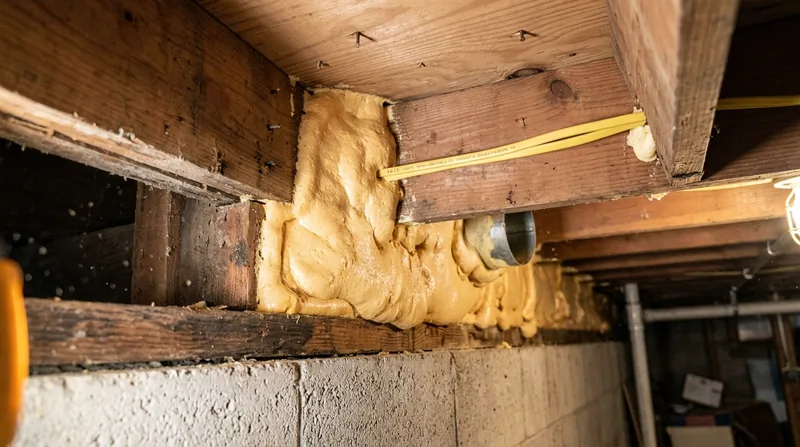




Closed cell spray foam insulation in Wichita delivers the dense, rigid thermal and air barrier that Sedgwick County homes need to stand up to our humid summers and cold, windy winters. The 1920s bungalows in College Hill and Riverside, the broad band of 1950s and 1970s ranches that spread across the metro during the aircraft boom, and the newer subdivisions in Derby, Andover, and Bel Aire all face the same pressure: air leaks through rim joists, top plates, and wall cavities, and the open plains wind drives that loss year-round. Closed cell foam seals those gaps with a continuous, impermeable barrier while adding structural rigidity and moisture resistance that open cell cannot match. Whether you are sealing a basement rim joist against spring drafts, protecting a metal building from condensation, or creating an unvented attic in a 1970s ranch, closed cell is the answer when air sealing and thermal performance have to work together. We have been installing closed cell spray foam across Greater Wichita since 2014, and we know exactly where Wichita homes leak and why.
Why Closed Cell Spray Foam Matters in Wichita's Climate
Wichita sits in IECC climate zone 4A, where the combination of humid summer heat and cold, windy winters creates two distinct failure modes. In summer, air conditioning escapes through poorly sealed attics and wall cavities, and in winter, warm indoor air leaks out through the same paths, while wind-driven rain and moisture accumulate in crawl spaces and rim joists. Closed cell foam stops both. Its high R-value per inch (roughly 6.0 to 6.5 per inch) means you get meaningful insulation in tight spaces, and its closed cellular structure resists moisture and air infiltration simultaneously. For homes built before 1980, where wall cavities are thin and framing is often single-stud, closed cell retrofit insulation adds real thermal resistance without removing drywall. For newer construction and metal buildings, closed cell controls condensation on steel and concrete, preventing the corrosion and mold growth that plague uninsulated barns and workshops across the farmland ringing Wichita.
- Closed cell foam creates an impermeable air barrier that stops wind-driven infiltration through rim joists, band joists, and basement walls in older Wichita homes.
- The high density and rigidity of closed cell adds structural bracing to attics and helps resist pressure changes during spring storms and high wind events.
- Closed cell resists moisture absorption, protecting metal buildings, barndominiums, and crawl spaces from the condensation and corrosion that thrive in Kansas humidity.
- Retrofit closed cell injection into existing wall cavities avoids demolition, making it the practical choice for pre-1980 stock where air sealing is the primary goal.
These properties make closed cell the workhorse of air sealing in Wichita, and the reason it outperforms open cell in applications where both moisture control and thermal performance matter.
Key info: A 1960s ranch in Wichita with uninsulated rim joists can lose 15 to 20 percent of its heating energy through that single path. Closed cell foam seals those joists and stops the draft, which is why rim joist insulation is often the highest-value entry point for a retrofit.
For more on how air sealing works alongside insulation, see our air sealing service page.
How We Install Closed Cell Spray Foam in Wichita Homes and Buildings
Closed cell spray foam installation is a precision job. The foam is mixed on site from two components held at specific temperatures, sprayed at a controlled thickness and density, and cured under mechanical ventilation. We measure every space on site, specify the R-value and thickness you need, and walk you through the process before we start. The work takes hours, not days, but the cure window matters: we keep mechanical ventilation running during application and for the full cure period, and we set a re-entry window of 24 to 48 hours before the space is fully occupied. That controlled cure is what separates a proper installation from a rig-and-run job where the smell lingers and the foam cures unevenly.
- We schedule a site visit to measure the space, identify air leaks, and determine the R-value and thickness required for your climate zone and building code.
- We prepare the substrate by sealing any active leaks, removing debris, and protecting adjacent areas from overspray.
- We spray the foam in controlled passes, building thickness and density to specification, never rushing or overshooting the target.
- We run mechanical ventilation during the entire spray and cure process to manage VOCs and ensure even polymerization.
- We trim and finish the foam, install any required thermal or ignition barriers per your local building code, and schedule your re-entry after the full cure window.
This methodical approach is what ensures the foam bonds properly, cures evenly, and performs as specified for decades.
Example: A 1950s ranch in Wichita with an unvented attic retrofit might require 5.5 inches of closed cell foam to achieve R-37 with a continuous air barrier. We spray that in two passes, run ventilation for 48 hours, and the homeowner gains both thermal performance and the pressure-resistant structure that helps the roof shed spring storms.
See our attic spray foam service page for details on sealed roof deck applications.
Closed Cell Spray Foam Methods and Applications in Wichita
| Application | Description | Why Closed Cell Fits |
|---|---|---|
| Sealed (unvented) attic retrofit | Spray 4 to 6 inches of closed cell directly to the underside of the roof deck, creating a conditioned attic space with no soffit vents. | Closed cell resists moisture intrusion from roof leaks and summer humidity, and its rigidity helps the roof resist wind uplift and pressure changes. |
| Rim and band joist sealing | Spray 2 to 4 inches of closed cell into the rim joist cavity and over the rim band, sealing the basement or crawl space perimeter. | Closed cell stops air infiltration through the rim joist, the biggest thermal weak point in Wichita's older homes, and resists moisture from the soil. |
| Wall cavity injection retrofit | Inject closed cell into existing wall cavities through small holes drilled from the exterior or interior, filling voids without removing drywall. | For 1920s to 1970s homes with thin cavities and poor original insulation, closed cell adds thermal mass and air sealing in one pass, avoiding demolition. |
| Metal building and barndominium closure | Spray 3 to 6 inches of closed cell to steel framing, creating a thermal and moisture barrier on the interior or exterior. | Closed cell prevents condensation on cold steel, stops air leakage through metal seams, and adds structural rigidity to large open spans. |
| Crawl space wall and rim sealing | Spray 2 to 4 inches of closed cell over crawl space walls and the rim joist, creating a continuous air and moisture barrier. | Closed cell resists ground moisture and soil vapor, and its impermeability stops drafts that otherwise pull cold air into the living space above. |
Closed Cell Spray Foam Insulation Cost in Wichita: What to Expect
Closed cell spray foam in Wichita typically runs from $1.20 to $1.60 per board foot, depending on the scope, access, and whether the job includes removal of old insulation or complex prep work. A board foot is one square foot of foam at one inch thick, so the total cost depends on the area to be covered and the target thickness. A rim joist seal on a 1950s ranch might be 300 to 500 board feet and cost $360 to $800, while a full attic retrofit on the same home could run 1,500 to 2,500 board feet and land in the $1,800 to $4,000 range. Metal buildings and barndominiums vary widely based on square footage and whether you are sealing the entire envelope or just specific problem areas. The biggest cost drivers are the area to be covered, the target R-value and thickness, whether existing insulation must be removed first, and the complexity of access and substrate preparation. If your attic has old fiberglass that needs to come out, if there are roof penetrations or HVAC ducts to work around, or if the crawl space has standing water that must be addressed before foam is applied, the scope and price adjust accordingly. We provide written estimates that specify the R-value, thickness, board footage, and total cost before any work begins. For a realistic quote tailored to your home or building, contact us for a free estimate or call (316) 618-7858.
See our full pricing overview for detailed ranges by application.
Closed Cell Spray Foam Insulation Near Me: What Wichita Homeowners Should Know When Hiring
Spray foam is a regulated product and a precise installation, so hiring the right contractor matters. When you are comparing closed cell spray foam installers in or near Wichita, verify that the contractor is fully insured and can provide proof of general liability and product liability coverage. Ask for references from recent jobs in your neighborhood, and contact at least two to ask whether the installer showed up on time, communicated clearly during the cure window, and was reachable if questions came up afterward. Request a written estimate that specifies the R-value, thickness in inches, board footage, and total cost, and that breaks down what is and is not included. If the estimate has no R-value or thickness, no mechanical ventilation plan, or a price far below market with no site visit, walk away. Permitting varies by city across Sedgwick County, so confirm with your local building department whether a permit is required and what thermal or ignition barriers are mandated by code. If you are in a master-planned community or HOA, check whether architectural approval is needed for exterior work on metal buildings or other visible improvements. Most closed cell jobs in Wichita do not require utility location, but if any excavation is involved, Kansas 811 locates are required by law. The best indicator of a professional installer is one who explains the cure window, runs mechanical ventilation, and sets realistic expectations about re-entry timing and cost. Contact us to discuss your project and get a no-obligation estimate.
Closed Cell Spray Foam Insulation in Wichita: Pricing Guide
| Service | Price | Details |
|---|---|---|
| Rim joist and band joist sealing | Starting at $1.20/board ft | Typical job 300 to 600 board feet, sealed rim and band joist around basement or crawl space perimeter |
| Attic retrofit with closed cell | Starting at $1.30/board ft | Sealed roof deck application, 1,500 to 3,000 board feet, includes removal of old insulation if required |
| Wall cavity injection retrofit | Starting at $1.40/board ft | Closed cell injected into existing cavities without drywall removal, typical 500 to 1,500 board feet depending on wall area |
| Metal building and barndominium closure | Starting at $1.25/board ft | Large-area spray to steel framing, condensation control, 2,000 to 10,000 board feet, price reflects economies of scale |
| Complex or mixed-scope job | On estimate | Crawl space with moisture issues, attic with roof penetrations, or combination jobs require on-site assessment |
| Estimate | Free | Written estimate with R-value and thickness specs, response within 24 hours, no obligation, call (316) 618-7858 |
Indicative pricing, the exact cost depends on square footage, finish, and site access. Free personalized estimate within 24h at (316) 618-7858.


