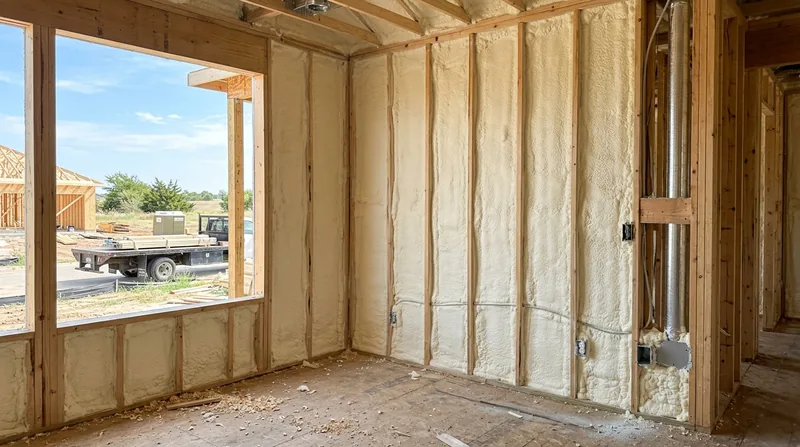




Commercial and new construction spray foam insulation in Wichita demands a contractor who understands zone 4A climate demands and the tight timelines of active job sites. Greater Wichita's building boom stretches across Derby, Andover, Maize, Bel Aire, and Goddard, where new subdivisions and commercial shells rise on the plains around Sedgwick County. The region's cold, windy winters and humid summers drive hard on any air leak or thermal gap left unfilled before drywall closes the wall. Builders and general contractors need spray foam applied before framing inspection, with controlled thickness, correct ratio, and mechanical ventilation during cure to meet code and avoid the smell complaints that derail projects. We work with commercial developers and production builders to spray closed cell and open cell foam into walls, rim joists, band joists, and sealed attic decks before your next phase begins. A free commercial estimate starts the conversation, and we move fast to fit your schedule.
Why Commercial and New Construction Spray Foam Matters in Wichita's Building Market
New construction in Wichita and Sedgwick County sits in IECC climate zone 4A, where the open-plains wind drives air through every gap in a wall or attic, and the thermal load swings hard between summer heat and winter cold. Fiberglass batts, blown-in cellulose, and loose-fill insulation leave air paths around fasteners, at top plates, and where rim joists meet the foundation. Spray foam seals those gaps as it insulates, and closed cell foam adds the vapor barrier and condensation control that metal-frame commercial buildings and sealed attics demand. Builders who spray foam before drywall avoid call-backs for drafts, moisture, and thermal bridging. Code compliance for ignition barriers and thermal barriers varies by city and building official, so we work with your local permitting authority to confirm what applies at your site.
- Spray foam seals air paths at top plates, rim joists, and penetrations that fiberglass cannot reach.
- Closed cell foam provides vapor control and condensation resistance on metal building frames and sealed decks.
- Open cell foam delivers R-value and sound dampening in interior walls and cathedral ceilings at a lower cost per board foot.
- We apply foam to spec before drywall inspection, holding your schedule and meeting your R-value and thickness requirements.
- Mechanical ventilation during cure and a stated re-entry window protect your crew and occupants from VOC exposure during application.
Correct installation is the foundation of code compliance and occupant comfort on every new build and commercial shell.
Key info: Sedgwick County building officials and city permitting departments in Wichita, Derby, Andover, Maize, and Bel Aire each govern ignition barriers, thermal barriers, and attic ventilation rules for spray foam. We help you navigate what applies at your address, and we defer all permitting questions to your local building department. Verify any contractor's credentials and insurance before work begins. NFPA fire code and IBC building code set national standards, and your city enforces the version in force at your site.
How We Work: Commercial Spray Foam Application on New Construction Sites in Wichita
Commercial spray foam work begins with a site walk and a clear conversation about your R-value target, thickness spec, and framing schedule. We coordinate with your general contractor and framing crew to spray after rough-in but before drywall, so the foam cures and off-gasses with mechanical ventilation running. We bring our own equipment and crew, set up containment where needed, and spray to your spec. Every job gets a written estimate with R-value, thickness per pass, board feet, and re-entry window stated in writing. We measure board feet on site, confirm your substrate is dry and sound, and walk away if moisture or contamination is present.
- We schedule on-site with your general contractor and confirm substrate conditions before mobilizing equipment.
- Spray foam is applied in controlled passes, maintaining manufacturer drum temperature and mixing ratio throughout the job.
- Mechanical ventilation runs during application and cure, with a re-entry window of twenty-four to forty-eight hours stated in your estimate.
- We provide a written estimate with R-value, thickness, board feet, and cost before any work begins.
- We inspect and document the finished installation, and you retain records for code compliance and future reference.
Coordination and clear communication keep your project on schedule and your crew safe during the spray and cure window.
Example: A new commercial shell in Derby, Andover, or Maize with metal stud walls and a sealed roof deck calls for closed cell spray foam to R-18 or R-21, applied to 2.5 to 3.5 inches per pass. We spray the walls first, then the rim and band joists, then the underside of the roof deck, with mechanical ventilation running the whole time. Your crew can enter and frame the next phase twenty-four to forty-eight hours later, depending on ambient temperature and humidity. See our closed cell spray foam page for technical detail on R-value and condensation control.
Commercial and New Construction Spray Foam Methods and Approaches
| Approach | Description | Best for |
|---|---|---|
| Closed Cell Spray Foam | High-density foam at 1.5 to 2.0 pcf, applied to 2.5 to 3.5 inches per pass, delivering R-6 to R-7 per inch. Vapor barrier and condensation control built in. | Metal building frames, sealed roof decks, rim and band joists, and cold-climate applications where moisture control is critical. |
| Open Cell Spray Foam | Lower-density foam at 0.5 to 1.0 pcf, applied to 5.5 to 7 inches per pass for R-19, with sound-dampening properties and lower material cost. | Interior walls, cathedral ceilings, and attic decks in new construction where budget and noise control matter more than vapor barrier. |
| Injection Foam Retrofit | Closed cell or open cell foam injected into existing wall cavities through small holes, no demolition required. Typical density 2.0 pcf, R-value 3.5 to 4.0 per inch. | Existing commercial buildings and pre-1980 structures where wall cavities need air sealing and insulation without removing drywall or siding. |
| Rim Joist and Band Joist Foam | Closed cell spray foam applied to the perimeter band joist and rim area where foundation meets frame, sealing and insulating in one step. | New commercial construction with slab or basement, and existing buildings where basement rim joists leak air and drive heating and cooling loss. |
Commercial and New Construction Spray Foam Cost in Wichita: What to Expect
Commercial spray foam pricing in Wichita is driven by board feet, foam type (closed cell or open cell), R-value target, thickness, and site access. A free commercial estimate is the starting point, and we measure on site to give you a firm number tied to your spec. Closed cell foam costs more per board foot than open cell, but delivers higher R-value per inch and vapor control. Metal building frames and sealed roof decks typically call for closed cell, while interior walls in new construction may justify open cell at a lower total cost. Substrate condition matters: if we find wet framing, contamination, or existing insulation that needs removal, that scope moves the estimate up and the timeline out. Getting two or three estimates from local contractors is smart practice, and comparing written specs (R-value, thickness, board feet, re-entry window) is the only way to know what you are paying for.
See our full pricing page for typical ranges and the factors that move cost up or down on your specific job.
What to Look for When Hiring a Spray Foam Insulation Contractor Near Wichita
Spray foam is a regulated trade, and the difference between a careful installer and a careless one shows up in air sealing quality, cure time, occupant safety, and long-term thermal performance. When you are vetting contractors near Wichita, Derby, Andover, Maize, or any other city in Sedgwick County, ask for a written estimate with R-value and thickness stated clearly. Ask about mechanical ventilation during cure and the re-entry window they guarantee. Call references and ask about smell, curing time, and whether the installer showed up for follow-up questions. Verify that your contractor is fully insured and can provide a certificate of insurance on request. Ask your local building department what permits or registrations apply in your city, and verify that any contractor you hire can navigate those requirements. If you are in a master-planned community or HOA, check your architectural guidelines for exterior work on metal buildings or commercial shells. Never hire a contractor who promises a price far below market, guarantees immediate re-entry, or cannot name the R-value and thickness they will spray.
Contact us for a free estimate and a conversation about your project, or call (316) 618-7858 to speak with a crew member who has done this work in your neighborhood.
Commercial & New Construction Spray Foam in Wichita: Pricing Guide
| Service | Price | Details |
|---|---|---|
| Free Commercial Estimate | Free | On-site measurement, R-value and thickness spec, board feet calculation, and written quote with no obligation to book |
| Closed Cell Spray Foam | Starting at commercial rate | Priced per board foot on site, typically 2.5 to 3.5 inches, R-6 to R-7 per inch, includes mechanical ventilation during cure |
| Open Cell Spray Foam | Starting at commercial rate | Priced per board foot on site, typically 5.5 to 7 inches for R-19, lower cost per board foot than closed cell, sound dampening included |
| Rim Joist and Band Joist Foam | Starting at commercial rate | Closed cell foam applied to perimeter framing, priced per linear foot and board foot, seals and insulates the thermal bridge in one pass |
| Injection Foam Retrofit (Existing Walls) | On estimate | Wall cavity depth, cavity condition, and access determine board feet and cost, typically no demolition required, written spec after on-site inspection |
| Travel and Mobilization | Included | No separate call-out fee or mileage charge within Wichita and surrounding service areas, equipment and crew travel included in estimate |
Indicative pricing, the exact cost depends on square footage, finish, and site access. Free personalized estimate within 24h at (316) 618-7858.


